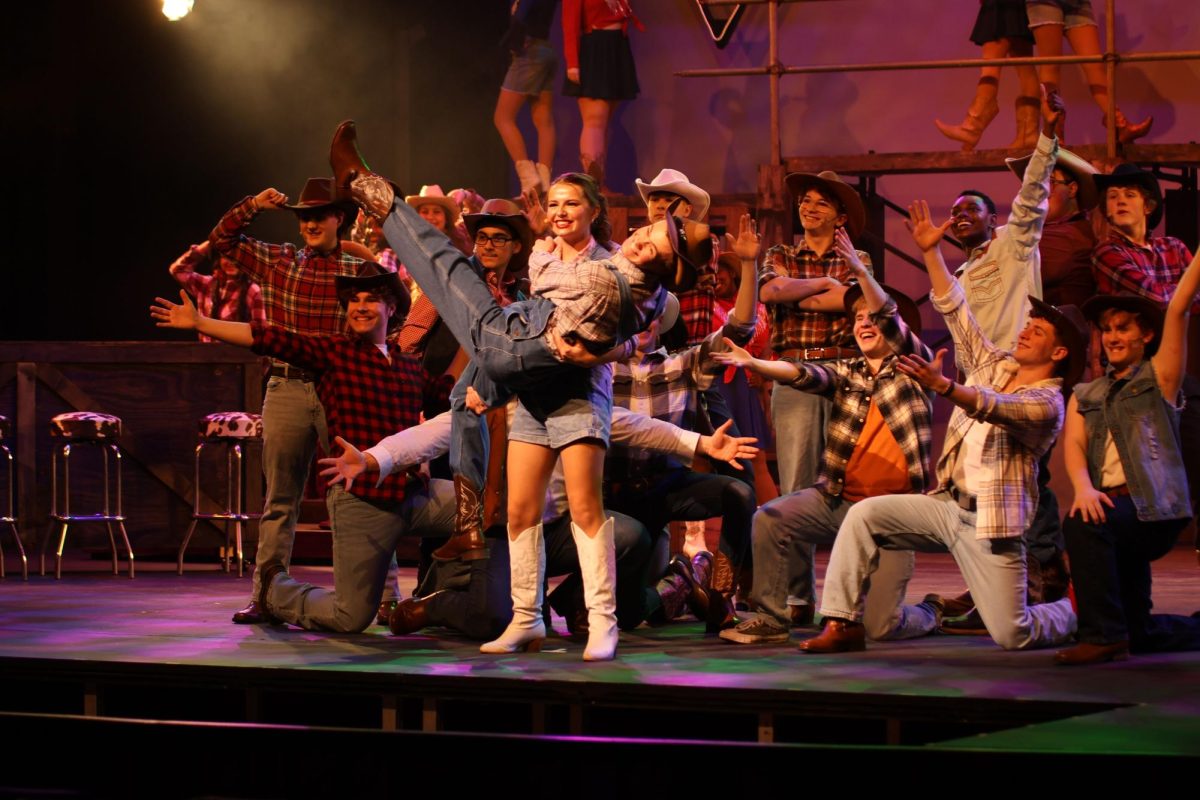
At first glance, this year’s production of Footloose follows a familiar pattern: auditions, rehearsals and choreography building toward opening night. But behind the scenes, months of technical planning and construction shape the performance long before actors take the stage.
Preparation begins with pre-production meetings between the director and technical director, where the script is analyzed and translated into physical requirements. For a show like Footloose, which features multiple locations such as a school, a church and outdoor settings, the production team must plan how to move efficiently between scenes without slowing the pacing.
For the director, choosing a musical is a balance of several factors rather than a single priority. Student ability is often the starting point, selecting a show that matches the strengths of available performers while still offering opportunities for growth. Audience appeal also plays a role, especially in a school setting where ticket sales and community engagement matter. Cost is another major consideration, including licensing fees, set requirements and technical demands.
“We create a short list of 3-4 possible musicals, we talk with the production team, Mrs. Blaydes, Ms. Meese, Mr. Depinto, Mr. Kieffer and myself to get everyone’s thoughts. Each of the musicals are analyzed further to see what would be the best for our school and community,” director and drama teacher Amy Sima-Dirham said.
Directing a high school production also comes with challenges that differ from professional theater. Students are still developing skills in acting, singing and time management, which means rehearsals must serve as both practice and instruction. Directors must balance pushing for a high-quality performance with creating a supportive learning environment.
“We look at the upcoming student talent. We can’t pick a show in which the musical may be out of the vocal range of our students. Or if we have more guys than ladies or vice versa, that may determine shows we consider,” Dirham said.
Those early discussions lead to a finalized design plan, including scale drawings of the stage, a build schedule and a materials list. Budget and time constraints play a major role in shaping decisions, often determining which set elements are constructed, reused or simplified.
Construction typically begins weeks before full cast rehearsals. Students working under the supervision of construction trades teacher, Chance Bricker, build platforms, scaffolding and rolling set pieces designed for quick transitions. Accuracy is essential, especially in a production that includes physically demanding choreography.
Once structures are completed, scenic painting adds visual detail. Painted textures help transform basic materials into believable environments under stage lighting. At the same time, the props team gathers and organizes items used onstage, ensuring they remain consistent throughout each performance.
Lighting and sound design develop alongside construction. Lighting designers program to reflect shifts in mood, while sound crews manage microphones and balance the band and vocals to ensure performers can be heard clearly.
“I take care of the pit orchestra, and that means I mix and master the entire band. In my opinion the band is what gives the musical life,” senior and sound designer Sophie Doerfler says.
All elements come together during tech week, when rehearsals shift from performance-focused to technical execution. Crews rehearse scene changes, test equipment and refine timing. This phase often reveals issues that must be resolved quickly.
“Set pieces moving quickly is difficult, especially with a limited crew. Moving around actors and keeping them quiet backstage is always a challenge,” junior and stage manager Gracie Michael said.
By opening night, the goal is consistency. Backstage crews follow detailed plans for moving set pieces and resetting props, while the stage manager calls cues to coordinate lighting, sound and action. The technical director oversees operations to ensure everything runs safely and efficiently.
Although audiences primarily see the performances onstage, the production depends on coordinated work across multiple technical areas. From initial design to final execution, the process reflects a combination of planning, engineering and collaboration.
The result is a performance that appears seamless but is built on weeks of work that largely goes unseen.