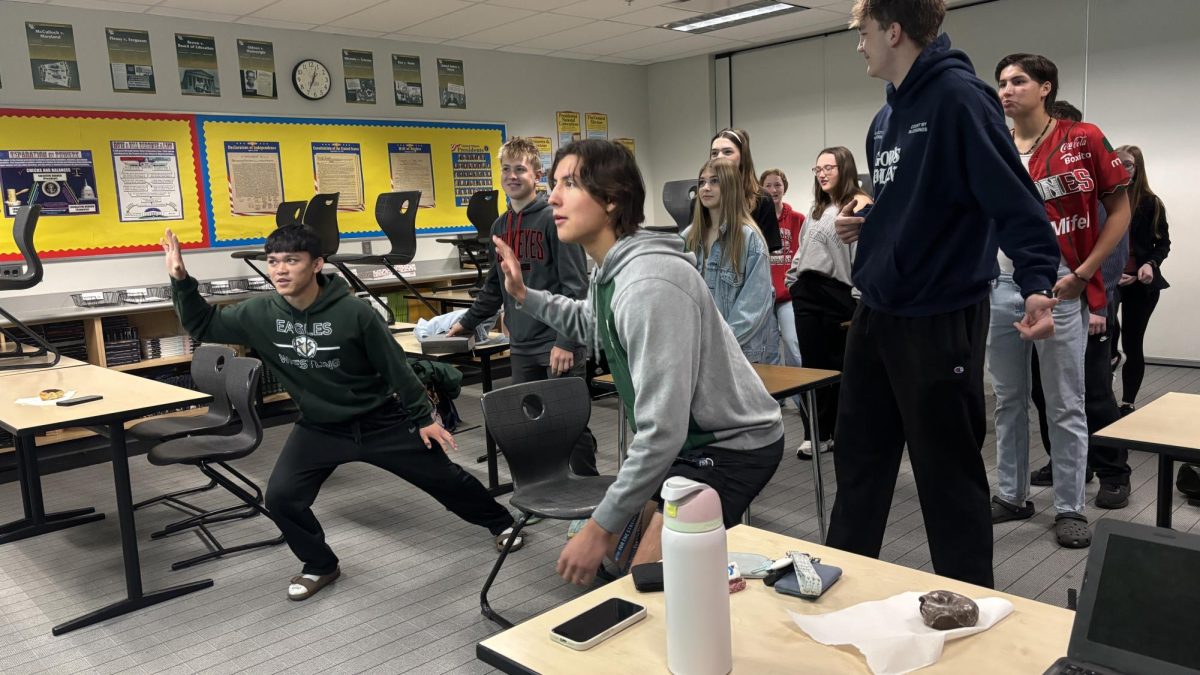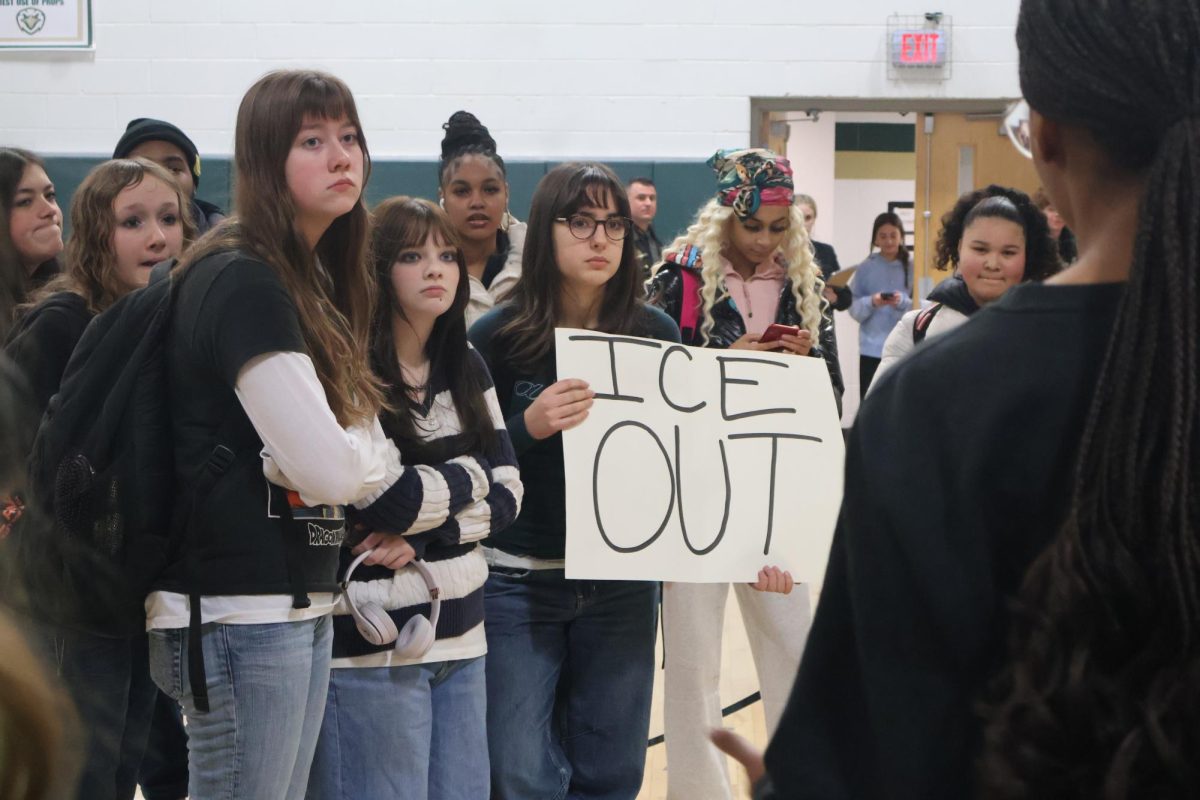
On Feb. 23, around 50 GlenOak students participated in a school demonstration against U.S. Immigration and Customs Enforcement (ICE).
The demonstration was originally set to be a walkout, and was later adapted to be a demonstration held in the main gymnasium after guidance from school administration.
Students planned to leave the building in order to display frustration against ICE’s increased immigration enforcement under the Trump administration.
“We have seen communities being torn apart but ICE and the government defend multiple wrongful killings and kidnappings of people,” senior Johari Abdul-Zahir said. “Our community is dense with rich culture and traditions and that shouldn’t have to be hidden because of hateful rhetoric and policies.”
Students learned of and planned the protest through social media.
“The walkout was planned by students through the class’ Snapchat stories and was set to occur at 10:30,” Abdul-Zahir said. “The plans for the walkout were spread through social media and word of mouth. Unfortunately, due to this, the plans and intentions were not always communicated correctly.”
After plans circulated on social media, administrators discovered the possibility of a protest and communicated their concerns with students walking out during the school day. This was done through a district-wide all-call sent out to parents that informed them of the protest, and urged students not to leave the building due to safety concerns.
“As the plans to walkout did not subside, Mr. Niarchos and Mrs. Pickering contacted Charlie and I as student leaders to redirect students to the gym. This was to prevent students from harm (weather conditions and outside threats) because the administration could not be outside with students,” Abdul-Zahir said.
Multiple students in the school were contacted by administration.
“We decided to call down student leaders that we know have various impacts across the student body,” GlenOak Principal Brent Niarchos said. “I did not know who was leading it at the time. I just talked to them about making the right decisions, and please use the gym for student safety.”
Senior Charlie Burton was one of these students.
“Due to the lack of organization and the amount of people who wanted to protest for the sole reason of skipping class, I originally wanted nothing to do with it,” Burton said. “I talked to the administration first period that day. Even though I was originally nervous, I decided that it could serve as an educational experience for further activism.”
The school demonstration held in the gymnasium occurred as an alternative to the walkout to prevent harm and allow students who wanted to have a conversation regarding ICE talk with one another.
“From my perspective, the staff wanted a way to protect student protesters while still amplifying their voices,” Burton said. “I feel they did what they could to keep students safe without censoring anyone’s beliefs.”
Administrators’ main goal was to keep students safe during the demonstrations.
“We wanted to try and provide the students with a safe environment, which was my number one concern,” Niarchos said.
There are also handbook policies in place that determine
“I would just say that I’m focusing on school policy, anything that says there is a disruption to the learning process is my biggest issue,” Niarchos said. “If they would have left the school and walked around the parking lot, past the flagpole, things like that, I would have considered it disobedience.”
These policies are influenced by the Tinker V. Des Moines court case. The case states students have their First Amendment rights as long as they do not cause a substantial disruption to the learning process.
“I think we can all agree that a walkout is a substantial disruption to the learning process. School officials do have a right to hand out punishments if there is some type of substantial disruption, if there is a walkout outside of the building , or even a large congregation in one place that disrupts the school day,” news staff adviser Angela Spano said.
There were about 30-50 students present at the demonstration. Some created signs to show their support for the cause.
“I made 16 small flyers with information about where and when the protest was. At the time, I called it a walk out and was planning on leaving the building,” senior Socrates Cook said.
Some students left the building, and others tried to leave, but were encouraged to turn around and go to the gym, which they did.
“Honestly, I went to the gym that day to see what would happen and how people would react,” Abdul-Zahir said. “After seeing students standing mindlessly in the gym, I along with my friends took charge to actually create conversation about the action we can take.”
Students held conversations at the demonstration regarding how to make an impact through action.
“We wanted everyone to do things with good intent and to make smart decisions and choices when it comes to advocating for important topics,” Abdul-Zahir said. “We talked about ways to make a change, such as boycotting, donating and even going to protests outside of school to make a difference.”
The students’ message was generally received well by those who attended the demonstration.
“There were people at the protest who said they learned more about pressured boycotts, contacting legislative directors and other forms of organized activism,” Burton said.
As with any form of protest, there are always individuals with differing opinions. Students handled those with different views from them maturely and effectively.
“Because it (the demonstration) was in the gym, there were also people looking in from the study hall above. During this conversation, someone shouted, “I support ICE,” and it caused an outburst of yelling and cursing,” Abdul-Zahir said. “We tried to de-escalate it by having people reflect on themselves. By telling them that they aren’t going to get anywhere by cussing and screaming; that you can’t let people get under your skin, you have to keep going and advocate respectfully using your voice. When people do things to make you upset, they want to get a reaction out of you so they can say something bad about your cause.”
Burton shared this sentiment.
“We reminded everyone that screaming back at them would not do anything to change their opinions, and that it was vital to focus on actions that could incite change,” Burton said.
Some felt that more should have been done to properly protest ICE’s actions.
“All we did was have a conversation, we didn’t actively do anything,” Cook said
Overall, students agreed that more comprehensive planning was needed for the demonstration.
“There were many misunderstandings, and that is simply due to the quick turnaround of the plans to have this opportunity in the gym,” Abdul-Zahir said. “I think that a protest needs to be held outside of the school. I think think-tanks and opportunities to have honest conversations can be good, but protests need to be outside where the people who can actually do something can see it. Not only that, but the way the protest is handled and planned needs to be more organized and methodical.”
Despite disorganization, students voiced their support for student activism.
“Student activism and advocacy is important because it shows people that the youth is capable and willing to do something,” Abdul-Zahir said. “That we won’t let things slide because we are young and that we are not powerless because we are young. It prevents issues like this from occurring again because the youth has already proven that they will fight and not let it continue into their future.”