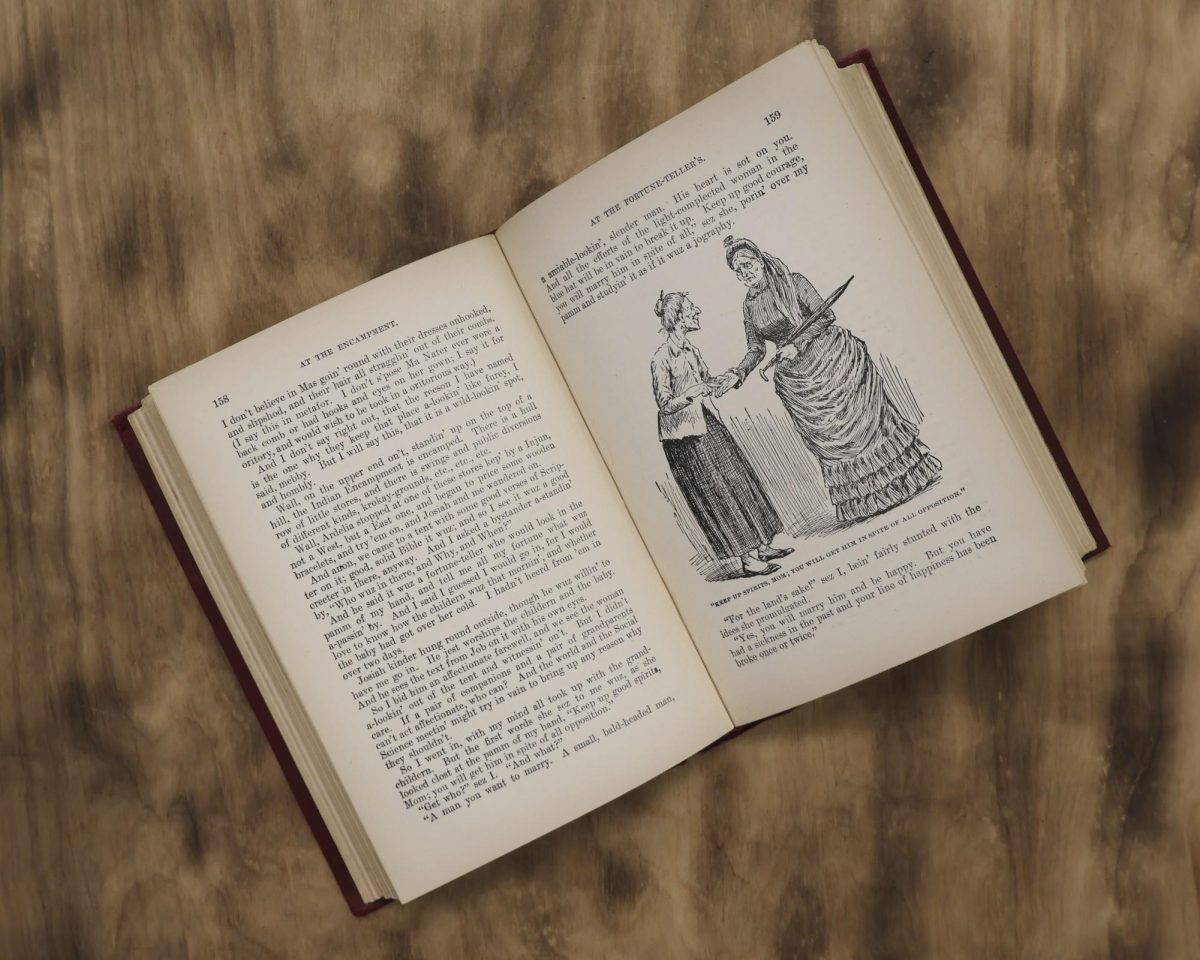
In October of 2025, I went to a massive underground book sale in Kent that had books from all walks of life for all walks of life. The sale contained everything from self-help magazines to 600-page thick books on Norse mythology.
In one of the corners of the concrete complex was a bookshelf labelled with “Vintage/Historic” that was sparsely filled, but I decided to check it out anyway. I enjoy reading and watching things from times long ago to try and envision what the times may have looked like in their entirety.
Most of the books were from the mid-1900s, but there was one from before that century: a book titled “Samantha at Saratoga,” published in 1887 by Marietta Holley. A book from “way back then” was enticing enough for me to buy it immediately.
When you open the book for the first time, you can practically feel how old and fragile it is. All of the pages are yellowed and feel like they may tear off if you treat them improperly in the slightest.
The foreword alone leads me to the most interesting aspect of the book; it is written in an older, more archaic version of the English language. “Probably” becomes “probable,” “ornamental” is written as “ornimental.” There are many words that were alien to me, and even now as I do research on the book and its author, I cannot figure out what they truly mean through words like “boddice” or “consuminer.”
On top of the historical English, it is also written as it would be said; you could say that the writing has a Southern accent to it. “Was” is spelt as “wuz,” “says” is spelt as “sez,” “partner” as “pardner.” It is a moderate challenge to read, let alone understand, which goes to show just how much language and vernacular has evolved over the years.
As for the plot, Samantha at Saratoga (which has an alternative title of “Flirtin’ With Fashion”) follows the titular character Samantha, who has just made it to the also titular town of Saratoga (how direct!). She becomes fascinated with the fashion and trends of the upper class who frequent the town.
She, along with the help of her husband, Josiah, tries to become a member of high society herself, as a rollercoaster of a journey unfolds. Her attempts to fit in (one of which includes, well, “flirting with,” which is to say revel in, the fashion) both succeed and fail, and she learns about just how important it is to be true to yourself, as well as how constricting societal norms can be: an idea the author has written many books about.
The book contains lots of drawings scattered throughout the story, some large enough to take up an entire page on their own. With that being said, I think it makes for a great way to get a grand picture of what life was like back then, especially the fashion.
There are several drawings of men in tailcoats and top hats, and city women wearing dresses with extremely tight corsets. Little girls took after their mothers and wore dresses as well, while the boys wore overalls.
For a book published almost 140 years ago, some of the problems presented in the novel still remain evident in today’s modern age. The class divide in the novel still remains relevant today: the middle-class has to work themselves to exhaustion trying to make their way up to the higher class, all the while being snubbed by them (in Samantha’s case, she was perceived as too unsophisticated to be considered an upperclassman). Arguably, it also makes a valid case for why consumerism is debilitating- Samantha spent lots of time to earn lots of money to spend on expensive fashionwear, and only then did she partly succeed in her goal.
And most prominently, it tackled the issue of the lesser degree of freedom women faced back then, a rather creative expression of it given by an interaction between Samantha and an older woman named Miss Flumm, who wished that the Statue of Liberty looked more like a fashionable woman, only for Samantha to point out the following:
“Why? How could she lift her torch above her head? How could she enlighten the world, if she wuz so held down by her corsets and sleeves that she couldn’t wave her torch?”
And that’s quite the profound statement to an otherwise humorous claim that the Statue of Liberty should look prettier.
Speaking of women’s rights, Marietta Holley, the author, was known for writing books that dealt with this issue, often by using her skill as a humorist and expressing her disdain through satire. That was as far as her impact reached, though, as she refused to make public appearances, even when the fight for women’s suffrage was being fought.
Most of her books were written under aliases, “Josiah Allen’s Wife” being the one she used most often. She wrote 25 books over her career that started in 1876, eventually becoming a bestselling author sometime in the 1890s.
An interesting fact about her life is only two of her books were written in locations she had actually been to- that being Saratoga (the location in this book) and Coney Island, relying on maps and guidebooks to envision the environments for her other stories.
Samantha at Saratoga offers a great view into life back then, and I do highly recommend this book to anyone who wants to learn more about the women’s rights movement in America and just life in the late 19th century in general. While you may never find a physical copy of the book, Project Gutenburg has a digital unedited version of the book that you can find here:
https://www.gutenberg.org/files/3425/3425-h/3425-h.htm
Authors as powerful as Halley have influenced lives around the world (the people of Europe often read her books as a humorous insight into American society), as well as their own when they fight for themselves- perhaps her work will influence your life as well, 137 years into the future.