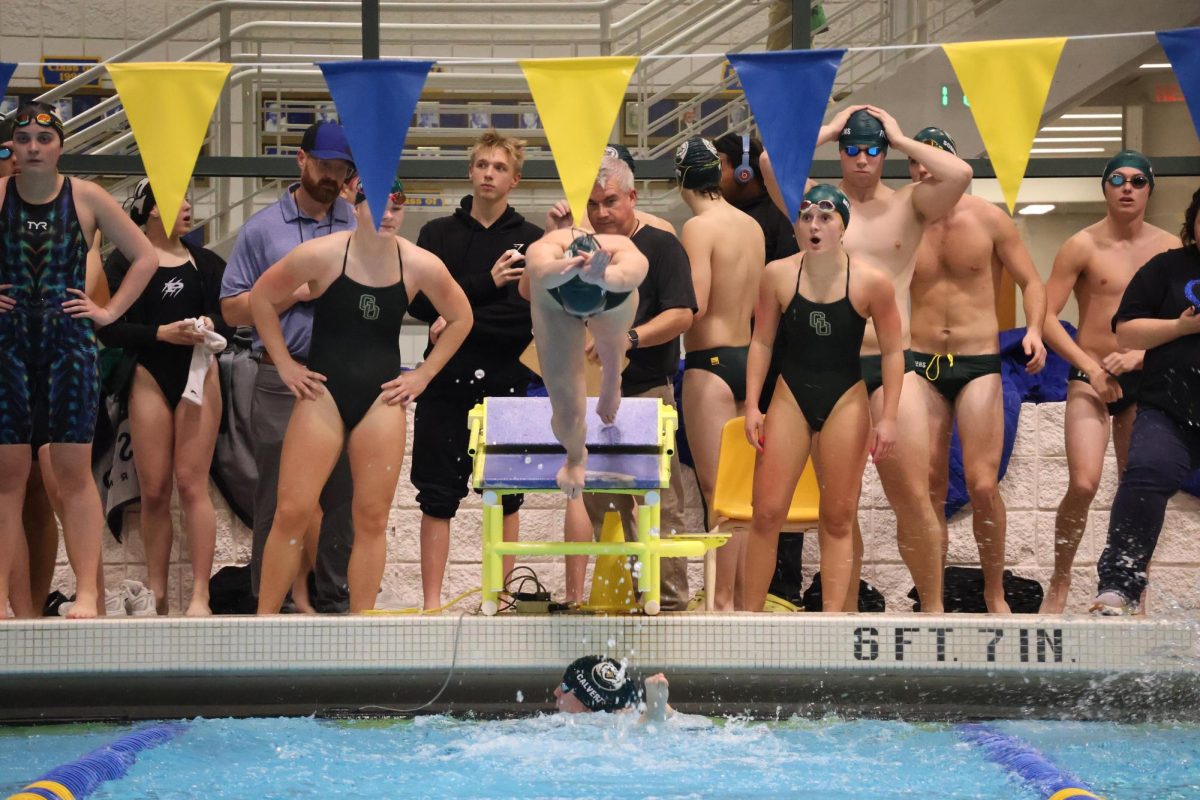
Every athlete wants to be the best, and every swimmer wants to be the first one to touch the pad at the end of the race. Little do swimmers know that it isn’t so much power that makes the race, but rather technique.
The time of the year has come where swimmers and coaches are in crunch time working on correcting technique with tighter streamlines, lower head positions and one of the bigger ones, flip turns.
The athletes that do these things correctly are usually the fastest swimmers in the pool and it goes to show how crucial good technique is for an efficient race.
“Proper swimming technique is in most cases more important than raw strength or conditioning. In the stroke part of swimming, proper technique allows you to pull more water more efficiently, in turn allowing you to swim faster and longer than someone with worse technique,” senior Soren Lewis said. “Proper technique in your starts, underwater and turns will allow you to maximize your momentum throughout the entire race.”
While many swimmers are very muscular, it doesn’t matter how much muscle you carry, but how good your technique is during the race. A large number of swimmers do not have perfect technique because they are either new to the sport or they simply need more time. This fact has a strong likelihood of leading to injuries that may set swimmers back from reaching their full potential or even ending their season.
“There are three very common ubiquitous errors in new swimmers. Head position is too high, breathing is too late and they cross over the midline with their hand, either during the entry above their shoulder or during the breath below their hip,” swim coach Zac Hawkins said.” “The rotator cuff takes a huge strain if you lift your shoulder over the water without rotating. Having a high head position during this motion makes the strain worse. High workload with poor technique leads to injury.”
The stroke is very important when attempting to become a faster swimmer, but the stroke is only a part of the race; the other part is the kick. A plethora of swimmers forget to kick and they just shovel water behind them. Depending on your stroke, the kick may be extremely more important than people think.
“Kicking in freestyle is important because without it, your legs become drag, uselessly towed behind you. Particularly important is the first few kicks off of the start and turn, as this allows you to delay the breakout, and maintain streamline for longer, with almost no energy expended,” Lewis said. “It is even more important in backstroke and in breaststroke. It is most important in breaststroke because the arm pull of breaststroke recovers through the water, and is therefore extremely inefficient.”
Depending on your event, the start, turn and finish of your race can either make or break the race. For a 50 freestyler, these fundamentals must be perfect or you must work hard to improve them if you have aspirations of being fast in your event. For distance swimmers, on the other hand, these things must be perfect if you are to be fast, but they do not matter as much for someone who is swimming for 23-26 seconds rather than someone swimming for multiple minutes.
These technique changes are extremely important, but some swimmers overlook the other hours of the day when they are not swimming and make poor choices that they do not even know are hurting them. These poor choices are not having a good diet, sleep schedule and hydration every day.
“ I encourage my swimmers to focus on their diet, hydration and sleep during the season as well as to cut out all chips and sodas,” Hawkins said.
Swimmers on the GlenOak team often ask what is wrong with consuming chips and soda? And/or does it make me worse as a swimmer to put these things in my body?
“It is the opportunity cost that matters and what a lot of swimmers do not understand. The opportunity cost is when you have the option to eat something that will taste good but do nothing good for you, or to eat something that will actually benefit you with protein and vitamins,” Hawkins said. “Chips aren’t bad for you, they are just empty calories. The problem is you’ve gotten no calcium, iron, vitamin D, vitamin C, potassium, protein, and so on from that meal.”
The bulk of youth swimmers today indulge themselves in mouth pleasure rather than fueling their bodies with stuff that will benefit them. They see an opportunity to please themselves and take advantage of that instead of eating boring healthy foods such as various meats and vegetables with high protein and iron. These things are about the other half of the swimming people forget about, which ultimately makes or keeps them slow through the season.
Being the fastest you can be ultimately depends on how much you want to be fast and how fast you want to get there. The swimmer who aspires to master and focus on the methods presented above and told to them by peers or coaches is a fast swimmer at the end of the season. Speed comes to those who take risks and suffer.