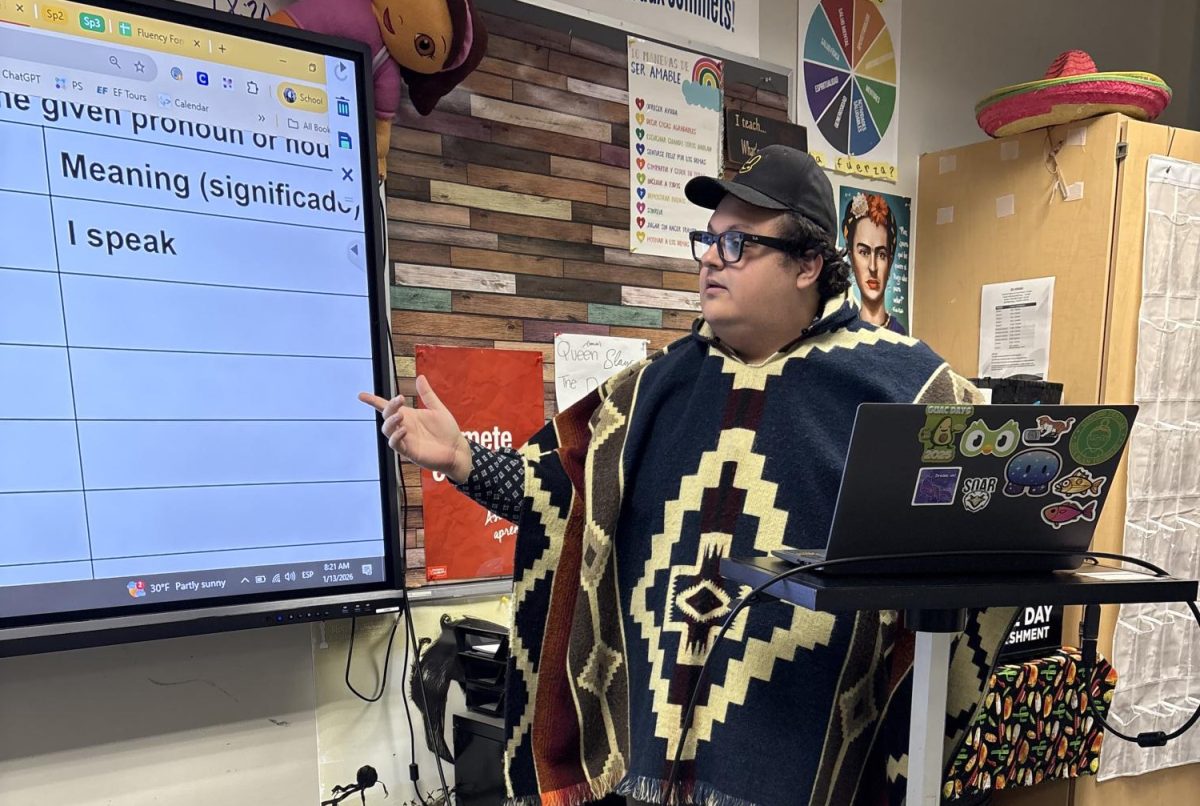
GlenOak High School offers various second language programs. The school values second language learning greatly. While the school highly suggests that students take a foreign language, I believe that the State of Ohio should require two years of a foreign language as a graduation requirement.
Bilingualism, or the ability to speak more than one language, is commonly associated with higher communication skills, as well as a heightened level of cultural awareness. However, research suggests that these benefits go beyond communication and cultural fluency. A strong conceptual connection between brain processing, communication, professional value and bilingualism can see a strong positive correlation.
In a recent student survey conducted at GlenOak, 16 out of 26 students said they believe bilingualism offers them economic or career benefits, while 12 students said it positively contributes to their character. This shows a trend that students view language skills as an asset, not just an academic benefit.
According to multiple studies, speaking multiple languages changes the way thought processes are undergone within the brain.
According to The Journal of Language and Linguistic Studies, studies found individuals were more efficient when expected to complete tasks requiring divergent thinking, a core process in idea generation. This demonstrates that there is a link between bilingualism and creativity within individuals.
According to The New York Academy of Sciences, physical differences are present between bilingual individuals and their mono-lingual peers, showing that bilingual individuals have higher concentrations of gray and white matter, which are linked to slower cognitive decline over time.
The magazine Scientific American, references a study that found that children who know two languages often found more specific categorization of colors. Because of this, they found an increased amount of color terms among the two languages. This showed a more specific thought process set of bilingual children.
As well as these cognitive differences, communication skills differences can also be seen between a mono-lingual individual and a bilingual individual. Research published in the The Annals of Regional Science, done on bilingual workers in a business setting shows that bilingual individuals are more aware of how their words are perceived and adjust their speech depending on whom they speak to.
This study found that the accommodation efficiency found within bilingual individuals allows for easier accommodation in communication, allowing for more efficient communication between a wider variety of audiences. This is incredibly beneficial and valued in many workplace settings and leadership roles.
Colleges and employers increasingly value multicultural confidence within communication and bilingualism, offering advanced communication efficiency, as well as stronger cognitive ideation abilities, which shows how being bilingual can be an asset to many of these colleges and employers.
Many degree programs require foreign language curriculum, demonstrating how much value is placed on bilingual education in the workplace, and future post-college endeavors.
These communication benefits, cognitive processing benefits and increase in professional value, show that language learning isn’t just a nonsensical requirement to fulfill.
For students in the State of Ohio in order to keep up with rest world knowing a second language is imperative to their education. Learning a language is about gaining a long-term advantage and level of competitiveness within an increasingly competitive academic and workplace environment.