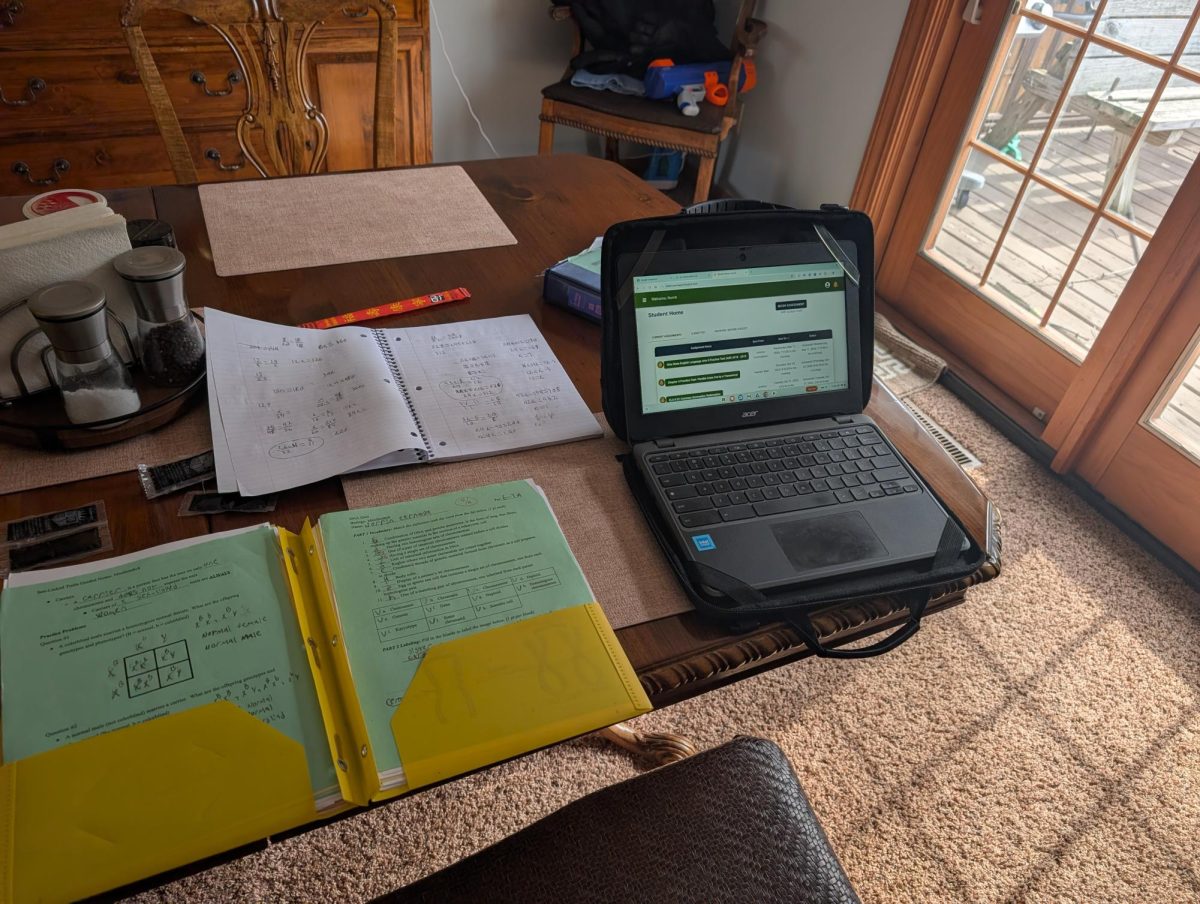
The second semester passed and students were anticipating their new classes, thankfully we have not had to endure the seemingly grueling truth of many high schools. However, college students have not had such luxuries this past transition.
With the passing of the second semester, college students had to endure the troublesome reality of exams. These cumulative tests usually happen at the middle and end of the semester in a collegiate setting.
However, mid-terms are still utilized in many area high schools, with GlenOak being the exception. Students at GlenOak High School may notice that mid-terms are not present in their classroom curriculum today.
Exams used to be a part of GlenOak coursework in the past. Sometime before the pandemic, GlenOak ended students taking exams.
The current education system in America is doing a disservice to students as indicated by dropping national test scores.
According to edworkingpapers.com NAEP scores dropped from 235 to an average of 218, making the need for education change evident. The National Assessment of Educational Progress, known as the NAEP, functions as the nation’s report on educational progress and effectiveness.
The evidence that exams promote students to retain information, can be argued against however, quarterly or semester exams could be the solution to this problem.
In order to understand the reasoning behind why we should have exams, it is important to understand the reason for abolishing exams in the first place. The reasoning behind it has caused much speculation and confusion, however two main reasons emerge.
Many people felt as if students at GlenOak were overtested considering the Ohio State Testing (OSTs), ACT and SAT testing as well as Career Tech, AP and IB Testing. Students’ mental health also played a major part in the reason for the change, because of the high amount of stress these tests caused, as well as the quantity of testing needed to be completed.
The concern for the effects of overtesting is understandable, but the abolishment of exams may have harmed students’ learning.
A 2013 study done in volume 40 of Teaching of Psychology reported that introductory psychology students who completed cumulative final exams retained more information on the subject than their non-cumulatively tested peers.
The study also remarked that introductory students benefited more from cumulative exams rather than upper-division course students. This places importance on the testing of pre-colligate students such as high school students, because they would receive the most benefit from the effects of exams. This shows that students receive educational benefits from exams.
An article done by Natalie Lawrence in the journal Applying Science of Learning in Education reports that the average of low-scoring students’ grades, and test scores increased by 5% and the standard deviation of their grades decreased by an average of 3 points.
This shows that exams help support low-scoring students and support them to get more consistent, higher test scores and grades. With consideration to the lowering NAEP scores, it becomes evident that something needs to be changed in our current educational system. The studies done on exams show that they benefit low-achieving students and increase information retention.
It is common practice at high schools in the area, that if a student has an A in their course they are not mandated to take an exam on the curriculum. This method allows low-achieving students to receive all the benefits of exams, without the excess effort of high-achieving students for little performance improvement.
In a time where study skills are not taught to students as much as they were in the past, it becomes apparent that students need to be taught how to study and have tests which provide feedback for their study abilities. If exams were still practiced at GlenOak High School, students would have a reason to study and teachers would have to teach study techniques to their students. Exams could help support students and combat the lowering of test scores in America.